
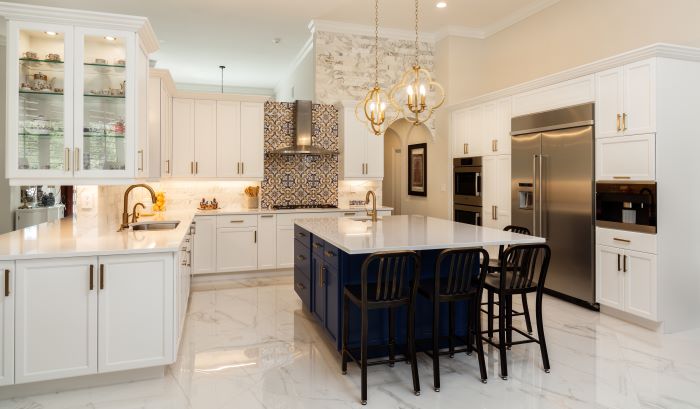
The popularity of open floor plans in today’s homes has created a need for clever and creative kitchen seating arrangements. The open floor plan by definition eliminates the separate dining room.
So where is everyone supposed to sit when they eat?
Today’s casual and informal lifestyle no longer includes a traditional kitchen dining table with chairs on all four sides. As a result, many homeowners are exploring different seating options to add a personal touch to their kitchen.
The most popular options for kitchen seating ideas that people are incorporating into their homes include:
- Kitchen islands with seating
- Peninsula seating
- Banquette seating
Let’s take a look at some of the most popular kitchen seating ideas for open floor plans.
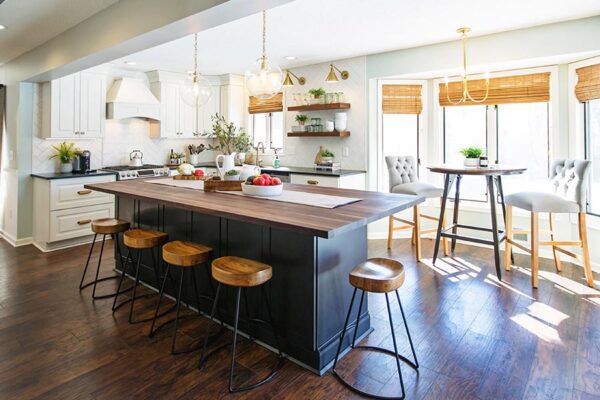
Kitchen Seating at Islands
Today, kitchen islands are one of the most popular ways to incorporate seating into an open floor plan. They provide space for casual meals, conversation, homework, WFH and food preparation.
The kitchen island also provides the most seating options. There is a great variety of functional kitchen seating arrangements around an island in the open floor plan kitchen that work well and look good.
Although islands are often shown in photos with the maximum number and size of seats that can fit, in real life, people actually take up more than just a seat’s width of space. Knees and elbows need room of their own.
Important Measurements for Planning Kitchen Seating Around an Island
Our research has shown that kitchen designers recommend planning seating early in the design process to ensure proper clearances.
The three different heights to take into consideration when planning the seating at an island are:
- Table height is 30” high
- Traditional counter height is 36” high
- Bar height is 42” high
How Many Stools? A common problem designers face is the homeowners want to fit in too many seats. They look at the island and say “we want seating for four.” Naturally, they want the number of seats at the island matched to the size of their family.
But the real spacing design guidelines suggest:
- 24 inches of width per stool
- sometimes 26 inches for comfort
Thus a 6-foot island (72″) realistically fits three stools, not four. Kitchen designers quietly remove a stool from the plan all the time.
Enough Knee Space. Another cabinet design issue homeowners don’t think about is knee space for island seating. That’s where you come in.
To seat comfortably, you want 15-18 inches of countertop overhang. Without that, people sit sideways because their knees hit the cabinets.
Walkway Clearance. Your homeowners need at least 4 ft. of open space around the island for walkways. This is especially relevant if seating is placed behind the island. Without this clearance, people sitting at the island block the work area.
One-Sided Kitchen Island Seating
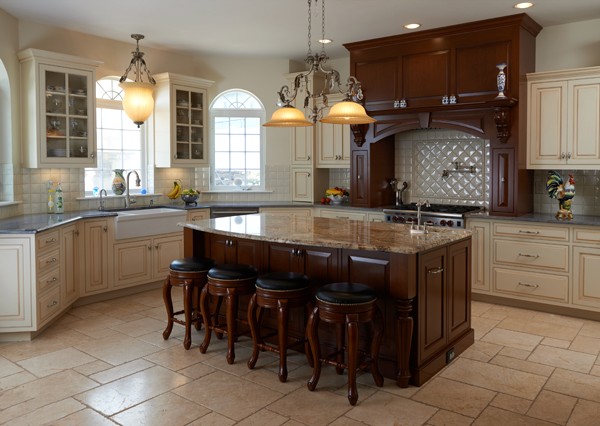
When the island is used for family meals, the seats should not be lined up on one side of the island with everyone facing in one direction, like strangers in a diner. Alternately, pulling a stool around to sit on the other side of the island means someone’s knees are bumping against the cabinets.
This arrangement looks good in photos we see on Houzz and Pinterest, but it doesn’t lead to family conversation. Or comfortable seating and eating for a family member.
Where there’s only two or three people who will be seated, the one-sided configuration is fine. If the island isn’t expected to be used for larger groups than that, it makes sense not to dedicate any more space to seating.
Islands with Decorative Elements that Restrict Kitchen Seating
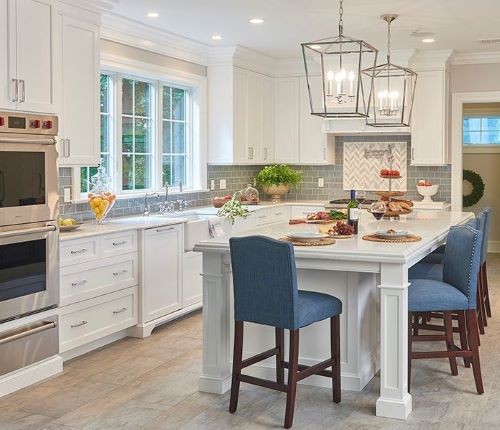
Here’s another thing to be aware of when planning island seating. If seating will be placed between island decorative elements like sides, posts or legs, this needs to be taken into consideration during the planning stage so they don’t interfere with legroom.
Choosing an island without sides will give more space for legs and knees and more flexibility to move a stool to the side so diners can face each other.
Two-Sided Kitchen Island Seating
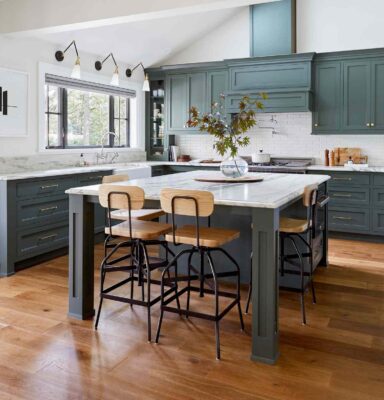
Adding seats to one adjacent side of the island can make it more inviting for eating. By extending the island overhang to two sides instead of just one, diners can sit facing each other.
Homeowners can keep seats on both sides all the time. Or they can save space by keeping seats on just one side most of the time and then pulling a stool over to the available shorter side when needed.
Three-Sided Island Kitchen Seating
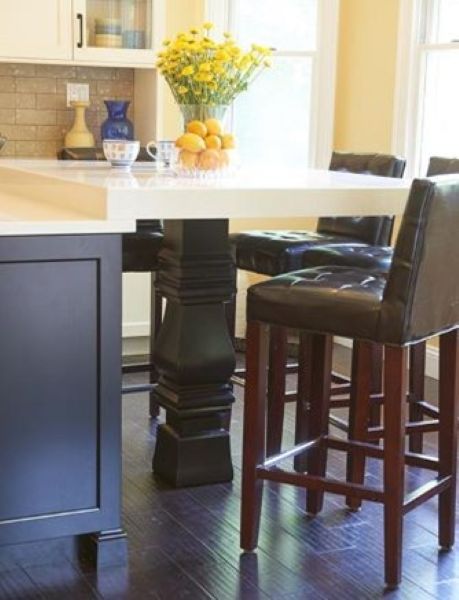
For homeowners who don’t like eating every meal while seated on bar stools, designers are increasingly attaching a table-height extension to the island. In this scenario, the island is built out to include a table, and people can use regular dining chairs instead of bar stools.
Compared with having a stand-alone table away from the island, three-sided seating takes up less floor area because you don’t have to leave “circulation space” between the island and table.
Of course, the trade-off is that your “table” has only three useable sides. However, for casual dining, this is a great solution.
Peninsula for Kitchen Seating
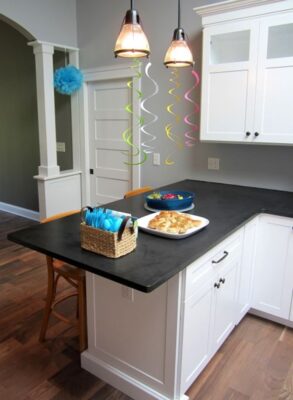
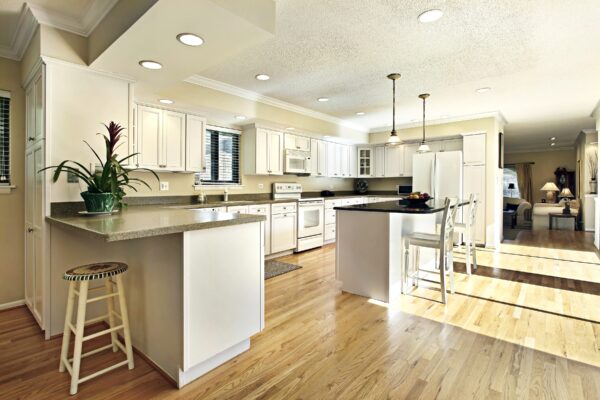
According to HGTV, “A peninsula is basically a connected island, converting an L-shaped kitchen layout into a horseshoe or U-shape.” Peninsulas are ideal for creating a home bar, a breakfast area or a snack space. It’s truly a combination of style and function.
On one side is a seating space, while on the other side is practical storage, such as roll-out shelves, deep drawers, possibly a super susan, or maybe a spice storage pull-out. As a bonus, the peninsula provides lots of counter space.
In addition, a kitchen peninsula creates a natural room divider, while keeping the kitchen and living spaces open
Kitchen with Banquette Seating
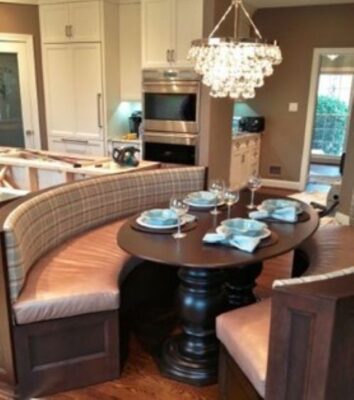
Banquette seating can really personalize a kitchen. It can be cozy, casual or elegant – whatever the clients want. It also offers a great space-saving solution, since fitted seating requires less floor space than a freestanding table and chairs.
The seat of the bench should be around 20″ high and the back of the bench should be around 42″ high.
The different ways banquette seating can be designed include:
- A bench on one side and chairs on the others.
- An L-shaped bench with chairs on the other two sides.
- A U-shaped bench surrounding three sides of the table, and an optional chair on the remaining side.
- Parallel benches facing each other, like a restaurant booth
A banquette comes with storage. You can hide things behind the closed doors or in the drawers below the banquette. With a kitchen open to other living space, this storage can be used for everything from extra placemats and serving pieces to crafts supplies and toys.
If your clients love the look of a banquette but they need the flexibility of a table and chairs, suggest to them that they can position a table in front of a banquette and place chairs around it.
Built in Bench Seating
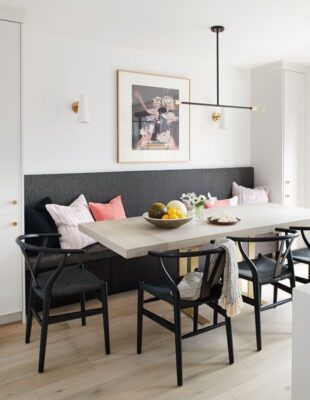
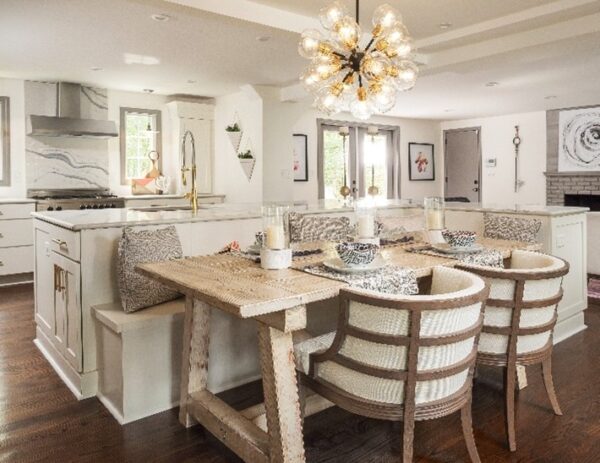
Built-in bench seating along a wall is another option homeowners are using in open floor plan kitchens. A simple bench paired with a table and a few chairs creates flexible seating while keeping the space visually open.
This configuration is not quite the same as a banquette. A banquette is usually wrapped into a corner or nook, while bench seating is often a straight run along a wall.
It’s popular now because it saves space compared to chairs. In addition it creates a casual, café-style feel.
Is a Two-Level Island Still an Option for Kitchen Seating?
In the past, many kitchens featured a raised bar or two-tier island designed to hide food preparation from the living space. Today, designers are moving toward single-level islands that provide more usable workspace and a cleaner look in open floor plan homes.
One exemption to the “no staggered island countertops” caveat applies to baking enthusiasts, as that lower height lets them fully extend their arms when rolling out or kneading dough. When the countertop material is granite or marble, the natural stone will stay cool when working with dough.
Personalize the Kitchen Seating
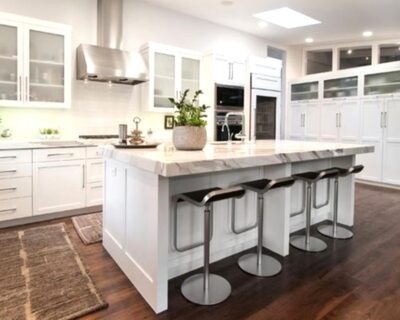
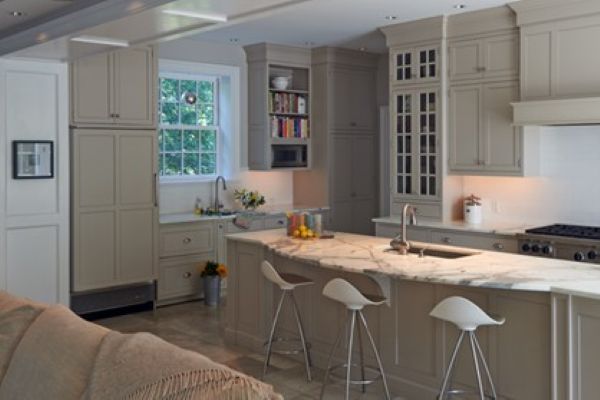
Decorating the kitchen in an open floor plan home can be fun and creates the opportunity for personal expression. Upholstered stools, unusual counter-height seats and colorful cushions can personalize an otherwise functional space.
However, when buying stools homeowners should be aware that many stools are too wide or bulky. Those with large backs and arms may be attractive, but they are going to restrict seating space. Suddenly the island that “seated four” now fits three at best.
That’s why designers increasingly recommend backless stools. Backless stools are replacing bulky bar stools in open kitchens because they slide under the island and keep sight lines open.
Conclusion
Although there are no hard and fast rules for where to place kitchen seating in an open floor plan lay-out, the kitchen flow must always be considered. No one wants people who are seated at the island getting splashed or burned or bumped into all evening. Seating should be situated so that diners can see and talk with the cook and others around them, with plenty of room for elbows and knees.
Related Articles
Frequently Asked Questions About Kitchen Seating
How many stools fit at a kitchen island?
Most kitchen islands comfortably seat two to four people depending on the island length. A 6-foot island (72″) realistically fits three stools with 24” allocated for the stools.
What height stools work best at an island?
Standard kitchen islands are 36 inches high, so 24”-27” high counter-height stools. Bar height is 42” so 30” high bar stools for 42” bar height counter
Is island seating enough for family meals?
In many open floor plan homes, island seating replaces a traditional dining table for casual meals and everyday use.
What are the best stools for island seating?
Designers recommend backless stools. Backless stools replace bulky bar stools because they slide under the island.
At Bob Aungst Cabinet Sales, we work with kitchen dealers and designers and design-build remodelers throughout Pennsylvania, New Jersey, Delaware and Maryland to help them plan cabinetry for real homes and lifestyles.