

Smart Appliances Are Still Very Much a Part of the Kitchen Conversation
But the Enthusiasm has Cooled
With all the advances in the smart appliances for your kitchen, it feels like we are getting closer to living like the Jetsons. Technology just keeps getting smarter.
As smart technology continues to evolve and more homeowners are living with smart appliances, we’ve updated this article to reflect how kitchen designers and homeowners are thinking about smart appliances today.

A few years ago, Wi-fi-connected features felt exciting and new. Today, many homeowners and kitchen designers are more cautious than curious. The idea of downloading yet another app, relying on cloud-based features, or wondering whether today’s “smart” technology will still be supported in five or ten years has made people resistant and skeptical.
There’s no denying the benefits of smart appliances: energy efficiency, automatic problem detection and time saving features. While certain functions—like remote oven control or maintenance alerts—can be genuinely useful, buyers are increasingly selective.
However, as more homeowners live with smart appliances, the downsides are becoming more evident. They cost more—so are they worth it? Do they still function when the internet goes down? Repairs when needed can be complex and expensive. Will they still work when technology moves on?
There’s also growing concern around privacy and data collection. Consumer Reports has raised questions about how much data smart appliances collect, how that information is used, and whether consumers fully understand what they’re agreeing to. (Kim Komodo had thought on this topic a couple years ago. Read on. )
How Long Do Smart Appliances Last?
A question every potential customer asks is compared to traditional appliances, how long do smart appliances typically last? Are they worth the extra cost? What is the value/cost ratio?
According to an industry expert: Smart appliances typically have a lifespan of 10-15 years. However, their “smart” functions may become obsolete after 5-7 years because software support has ended or technology has moved on. Traditional appliances often continue working for 15-20 years. That refrigerator in your garage that belonged to your parents? Still working just fine since the year 2000.
Kitchen Designers Aren't Sure About Smart Appliances
Homeowners are not the only group not eager to jump on the smart home bandwagon. Kitchen designers are not enthusiastic either.
A NKBA report indicates that designers are behind in adopting smart home technology. Only thirty percent of designers surveyed said they have integrated technology into kitchen projects.
As kitchen designers, you are expected to be experts on every aspect of the kitchens you create. It is challenging enough to keep up to date with design trends and ever-changing appliance models. However, it appears that smart home technology may be the toughest challenge yet.
The Experts Have Concerns about Smart Appliances and Privacy
Do you know Kim Komando?
She is the host of two daily radio shows and one weekend radio show about consumer technology. On her weekly call-in show, she provides advice about technology gadgets, websites, smartphone apps, and internet security.
The Kim Komando Show is broadcast and syndicated on over 435 radio stations to an estimated 6.5+ million listeners. She hosts podcasts served to over 300,000 listeners per week. The Kim Komando Television Show premiered globally on Bloomberg TV on January 5, 2019. Kim Komando also hosts a weekly radio show on SiriusXM’s Business Channel 130 called Tech Insights.
Kim Komando is not a Fan of Smart Appliances
In addition to these impressive credentials, she is a HUGE advocate for privacy on the internet. Here’s what she has to say about smart appliances.
It’s no secret our devices spy on us. The shocker is that it goes way beyond smartphones and laptops. That smart fridge just might be tracking your eating habits and selling them to advertisers.
The research group Which? discovered many popular household appliances and gadgets share private information with tech giants like Google, Amazon, Facebook and TikTok. These companies take far more data than they need for the device to function correctly.
Which? researchers found the Google Nest suite of products, which includes everything from doorbell cameras to heating control systems, gathers a “huge amount” of location information.
LG collects the most data of all washing machine brands, including precise location and phone contacts.
Kim’s parting advice? Your data is worth a whole lot of money. It’s up to you to protect it.
Help Protect Your Clients' Privacy
Try these methods to help your clients protect their privacy:
- Caution them to be aware of what they say out loud to smart assistants. If they say something private, go to the device’s settings for a feature that allows them to delete recorded commands and conversations.
- They can disable information sharing with third parties. Again, the commands to do this can be found in the appliance’s settings section.
- If their appliances have cameras and/or microphones, ask the client to consider disabling them.
- On their smart TV, they should turn off automatic content recognition (ACR) to prevent the device from sharing data on their family’s viewing habits.
Still Want to Recommend that Smart Fridge?
Do you remember how excited everyone was when the first smart appliances appeared at KBIS? A refrigerator with a camera built into the door? An oven you could control from your smart phone while you were still in the office?
It was a brave new world.
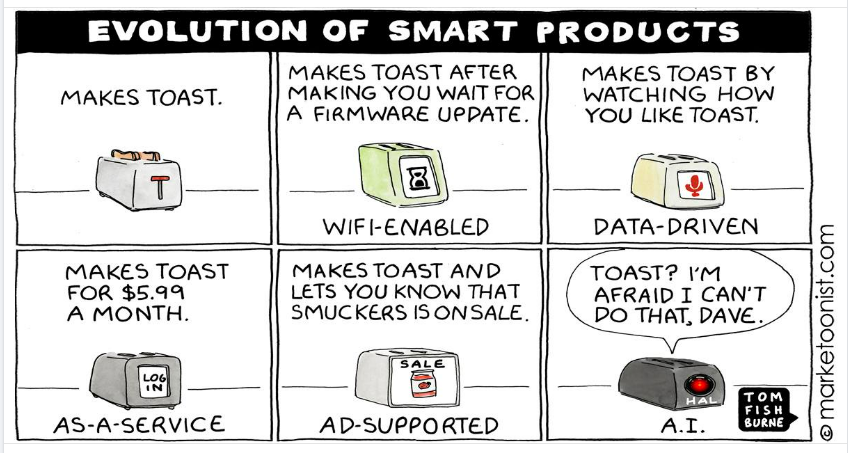
Ten years or so later, we’ve learned a lot of the pros and cons of smart appliances. Not only are they expensve and the technology goes obsolete every year, now we find out they are spying on us and sending information about our location, spending habits, eating habits and shopping habits. Goodness knows what else they’re spying on. So caveat emptor, as the saying goes. Is having a dishwasher that “tells” you when you’re almost out of detergent worth having your privacy compromised?
Bob Aungst Cabinet Sales is a full-service rep agency with the goal of matching kitchen designers and remodelers with the cabinet manufacturers best suited to their business’ style and clientele. Owner Bob Aungst III represents Brighton Cabinetry, US Cabinet Depot, Integrity Cabinets and Homestead Custom Cabinetry.