
Cherry is a Classic Wood Worth Another Look
Cherry wood kitchen cabinets are undeniably beautiful, thanks to the wood’s rich red color and straight grain. Cherry doesn’t need to compete with White Oak by pretending to be like White Oak. Its appeal is warmth, fine grain, color development and character.
Although American Black Cherry has long been associated with traditional styles such as Mission, Farmhouse and Shaker, it works just as beautifully in contemporary kitchens.
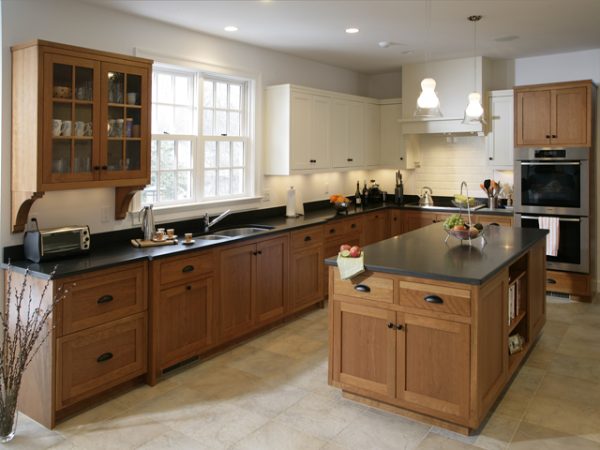
What Makes Cherry Different?
Cherry has a uniform, satiny smooth texture. Because it’s a closed-grain hardwood, it accepts stains like a dream. The wood’s random swirls, gum streaks and pin knots become more pronounced as Cherry wood naturally darkens.
Cherry wood has a lot of natural variations in color and tone. It can show a range of colors, from reddish-brown to blond. However, it is best known for its striking signature deep red color.
The Big Story: Cherry Changes Color
Cherry wood is a favorite choice for kitchen cabinets because of its distinctive aging process. Cherry is unusually photosensitive. It mellows with exposure to both natural and artificial light, and as it is exposed to the light, its color will slowly darken over time.
This darkening process actually begins when the wood is first cut. As it is exposed to light, the wood gradually turns into the rich brown-red shade cherry wood has been known for.
The speed and degree of the change can’t be predicted precisely. Different areas of cabinetry can darken at different rates depending upon light exposure. Wood experts confirm that sunlight will most likely change the color in unpredictable ways.
When wood comes from different trees, individual pieces can also darken at different rates. That natural variation is part of Cherry’s character—but it is also why customers need to understand that a finished kitchen may not have perfectly uniform color.
This is exactly where samples can mislead: even NKBA has cautioned that aged Cherry samples may not represent newly produced cherry because of oxidation/color change.
Cherry Doesn't Stay the Color the Customer Bought
Say it again: Cherry doesn’t stay the color the customer bought. Cherry is beautiful precisely because it changes. Make sure your customer understands that before their order is placed.
Many homeowners consider this characteristic of cherry wood to be a desirable feature. They specifically request Cherry for their kitchen cabinets for this reason. They like the natural variations and enjoy seeing the color of their cabinets mellow over time.
Then there are people who want to see their installed cabinets look like the sample they selected. Further, they expect the color to remain consistent forever.
If your clients are especially particular about the color palette in their new kitchen, then the changing color of cherry wood may be a turn-off for them.
Designers need to explain how Cherry is sourced and finished, and why even carefully manufactured cabinetry will show natural color variation and continue to change over time.
Natural Variation Is a Feature—Until the Customer Thinks It's a Defect
Naturally occurring variations in the wood contribute to the beauty of Cherry cabinets. Each piece of wood has its own distinctive traits. The type of soil the tree was grown in, the weather, even the amount of moisture and sunlight have effects on grain and color variations.
No two Cherry trees are exactly alike. Hardwoods like Cherry and its hardwood veneers will vary in grain patterns, color and the amount of naturally occurring mineral streaks, knots, pitch or gum pockets, pith flecks or worm tracks. These variations mean each piece of wood is unique and the homeowner’s cabinets will be one-of-a-kind.
Make sure your customer understands the variations they will see in their finished cabinets.
Explain every little detail to them. Show photos of completed kitchens and samples of Cherry in several finishes so they understand what the wood actually looks like—not just what one small sample looks like.
Read about one customer who did not understand what his Cherry cabinets would actually look like, and how you can avoid a similar situation.
Character Cherry
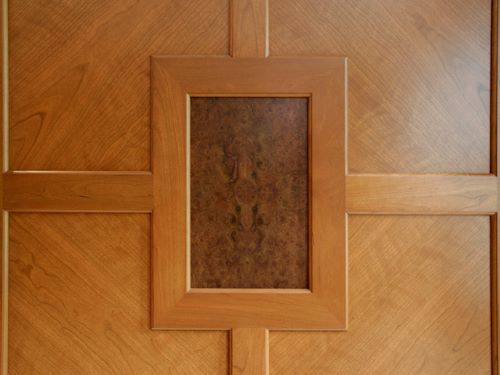
If your customer likes Cherry’s natural characteristics, introduce them to Character Cherry that showcases them rather than minimizing them.
Character Cherry allows more of the wood’s naturally occurring variations to become part of the design. Expect greater color variation along with knots, mineral streaks, gum or pitch pockets and other characteristics that may be limited in more selectively graded Cherry
Many people who like the look of wood love these rustic details and natural characteristics.
The photo shows a cherry kitchen cabinet door with a character cherry inset panel. The designer specified character cherry to create a vivid contrast to the solid wood cherry panel.
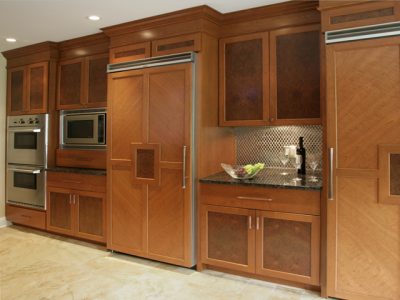
Natural Cherry vs. Stained Cherry
Cherry wood’s closed grain accepts stains well and finishes beautifully, creating a wonderfully smooth finish.
Natural and light finishes allow cherry’s variations, gorgeous red color and aging progression to show prominently. Few finishes are as stunning – and as timeless – as a Natural Cherry cabinet finish.
Other stains work equally well, of course. Darker stains change what the eye notices.
Cherry cabinets are rarely ever finished with paint. The reason for choosing Cherry for cabinetry is to reveal the natural graining and beauty and enhance the wood, not cover it.
Does Cherry Look Dated?
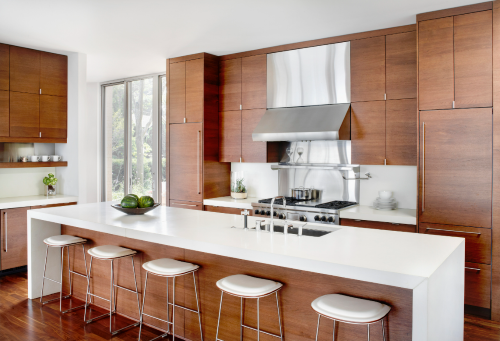
If your clients are nervous about choosing Cherry because it’s “old fashioned” or too traditional, you can honestly recommend Cherry by reminding them that the wood itself isn’t what dates a kitchen, it’s the way it is used in the kitchen design. The broader 2026 trend toward natural wood, simpler profiles and softer finishes gives you a very nice contemporary context for that argument.
If your clients are nervous about choosing Cherry because it feels ‘old fashioned’ or too traditional tell them it isn’t Cherry itself that makes an old cherry kitchen look dated. It’s those 1990s/early-2000s kitchens with raised-panel doors, ornate moldings and onlays, dark reddish finishes, dark granite, traditional hardware—the entire design dates the space.
Homeowners today want to connect to nature using natural and nature-inspired products. They want a new kitchen with life that feels lived in, making cherry wood a logical choice.
Select Cherry for one of today’s popular flat panel door styles with a light or natural finish, affix sleek decorative hardware, use natural stone countertops or hand-painted backsplash tiles and it’s a completely different kitchen.
Is Cherry Right for Your Customer?
Cherry is a good choice for the homeowner who
- appreciates natural wood
- can accept the wood’s naturally occurring characteristics
- wants the warmth of Cherry’s beautiful red color
- understands that the color of the cabinetry will darken over time
Cherry is less appropriate for the homeowner who
- expects every door to match the sample precisely
- wants wood with no knots, pinholes or mineral streaks visible
- wants perfectly uniform color
- will be upset when the wood changes
Conclusion
Cherry is not like almost any other cabinet wood your customer will choose. Its color varies and it changes after installation. Its natural markings are part of the material. These features can make for an extraordinary kitchen—but only when the customer knows what they’re buying.